


The Crossroads: Why We Didn't Just Adapt - We Transformed
Compliance is often the floor, not the ceiling. When new regulations reshape an industry, most businesses move to meet the minimum requirement. Do what's necessary, keep operating, move on. That's a rational response. It's also a missed opportunity.
When the 2024 crystalline silica regulations arrived, we took a different approach. And it changed everything.
The Easy Road and Why We Didn't Take It
We had options on the table that would have technically satisfied the new requirements without a fundamental product overhaul. We could have adjusted formulations, sourced partially compliant materials, positioned the change as a quiet update. The business could have continued largely as before.
But we asked a question that changes the answer: what would it look like to build the best possible surface product, not just one that passes the test?
Once you ask that question, settling for the minimum becomes very hard to justify.
A Decision Grounded in Values
We had built our reputation on honest advice and genuine quality. Cutting corners on a health and safety issue (even a technically legal one) wasn't consistent with who we are as a business or as a WA team with real relationships to protect.
There's also a practical reality: the surfaces industry was changing and it wasn't changing back. Crystalline silica-free wasn't going to be a niche requirement for long. It was going to become the expectation. Getting there early and getting there properly, was both the right thing and the smart thing.
Rebuilding From the Ground Up
We made the decision to completely reformulate. Not to patch the existing product, but to build a new one, one that was crystalline silica-free by design, not by exception.
The result was a glass-resin composite: a surface made from up to 86% amorphous glass and 14% advanced resin binders, with no crystalline silica content. The composition offered something we hadn't expected: in many ways, a technically superior product.
The performance characteristics were compelling. Non-porous. Non-staining. Scratch, impact and crack resistant. Waterproof and frost resistant. Dimensionally stable. Hygienic and suitable for food preparation surfaces. No sealing required on polished finishes. Backed by a 10-year limited warranty.
It wasn't just safe. It was better.
The Stone Benchtop Category, Reinvented
Here's the thing: the demand for stone benchtops in Perth hasn't gone anywhere. Homeowners are still renovating kitchens. Builders are still specifying surfaces. Designers are still sourcing benchtops that look like stone. The category exists, it's just that the product powering it has fundamentally changed.
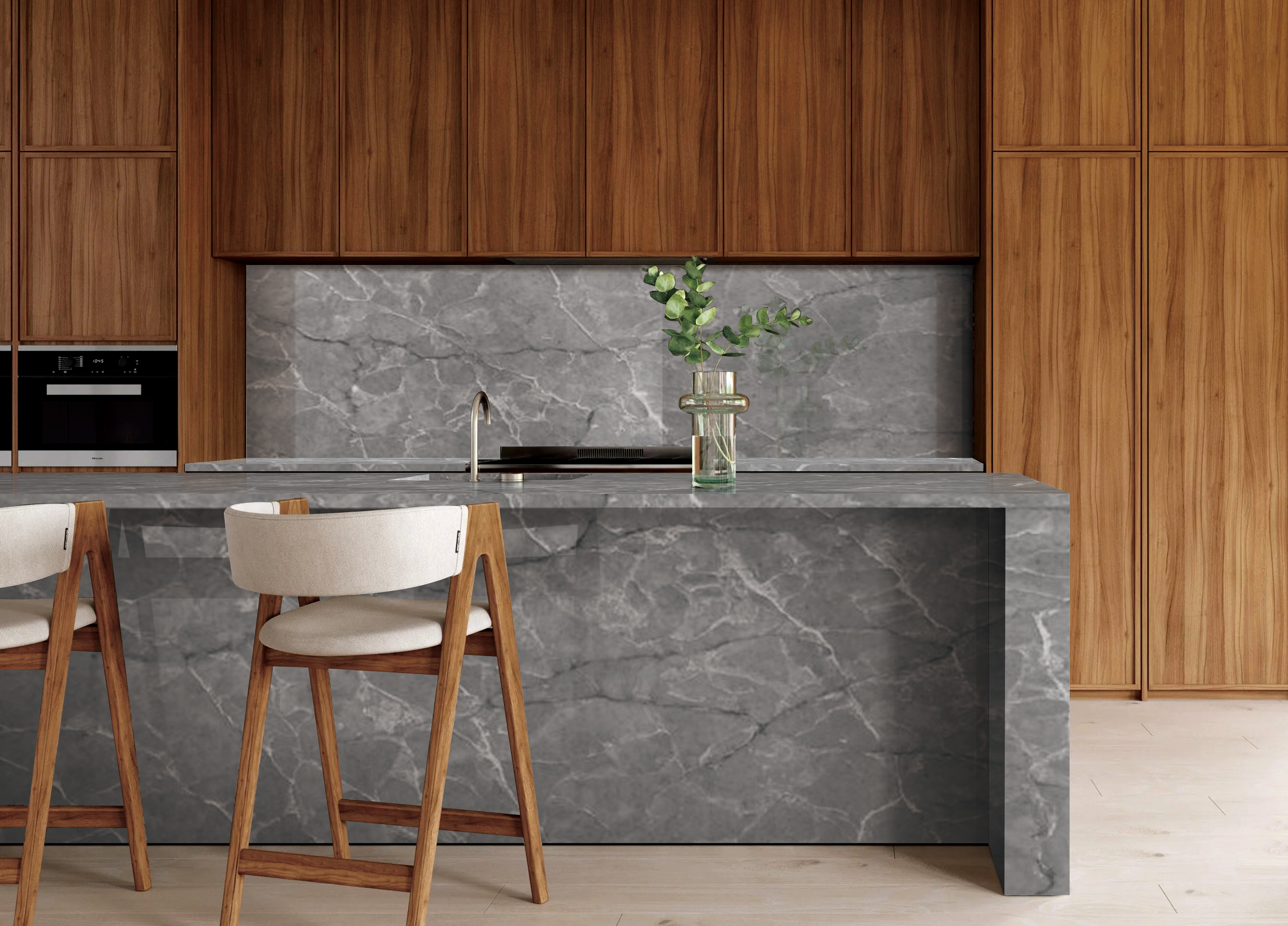
VITRUM is our answer to that shift. If you've been searching for stone benchtops in Perth, VITRUM is what that search is now pointing to, a crystalline silica-free surface with the same aesthetic appeal, better technical performance and none of the health risks associated with traditional engineered stone.
More Than a Rebrand
At this point, we knew we weren't just updating a product. We were launching a new one and the QSTONE name no longer captured what we had created. We needed a name that reflected the material at the core of the new product: glass.
In Part 4, we go deeper into the product itself, what VITRUM surfaces are made of, how they perform and why the glass-resin formula is the right foundation for this kind of surface.

